Pantry guide 01 · Olive oil
How to choose extra virgin olive oil
A bottle of olive oil is closer to fruit juice than to vinegar: it starts fading the day it is pressed. Here is how to read the label, judge freshness and keep a good oil good.
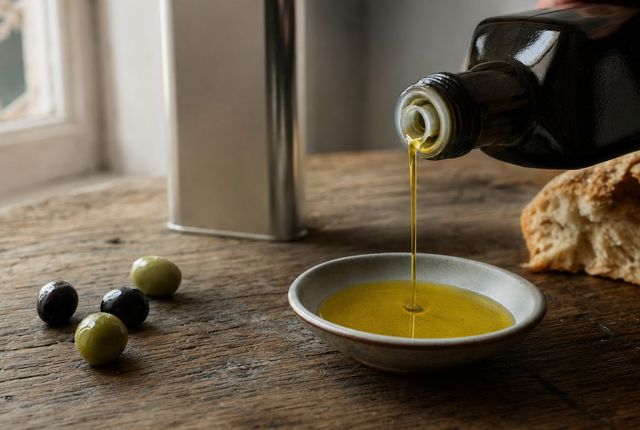
Illustrative photograph
The grade names, and what they hide
Most supermarket shelves carry four or five olive oil grades, and only two of them are unrefined. The names were set by the International Olive Council and mirrored in US grading standards, but the marketing words printed around them do a lot of muddying.
Extra virgin is the top grade. The oil comes from olives crushed and separated by mechanical means only, with no chemical refining, and it has to pass two tests: a lab measure of free acidity (no more than 0.8 percent, expressed as oleic acid) and a trained tasting panel that finds some fruitiness and no sensory defects. Virgin olive oil is also unrefined but is allowed slightly higher acidity and minor flavor faults.
Everything below that has been refined. Refining strips color, aroma and most of the bitter, peppery compounds people buy extra virgin oil for, and producers then blend in a little virgin oil to bring back some flavor. That blend is what gets sold as “olive oil,” “pure olive oil” or “light olive oil.”
| Grade on the label | Refined? | Flavor | Best use |
|---|---|---|---|
| Extra virgin | No | Fruity, often bitter and peppery when fresh | Everything, especially raw and finishing |
| Virgin | No | Milder, small defects allowed | Everyday cooking |
| Olive oil / “pure” | Mostly | Neutral with a faint olive note | High-volume frying and baking |
| “Light” olive oil | Mostly | Very neutral; light in taste, not calories | Baking, mayonnaise |
| Olive pomace oil | Yes, solvent extracted | Neutral | Commercial frying |
“First cold press” is mostly a holdover. Modern mills crush olives, mix the paste slowly, then spin the oil out in a centrifuge, so there is no second pressing. In the European Union, “cold extraction” has a specific meaning: the paste stayed below 27°C. Outside the EU the phrase is not policed the same way.
Decode a real label in thirty seconds
Front labels are designed to sell. The useful information is usually small and on the back. Tap each line on the sample label to see what it tells you and how much weight to give it.
Sample Estate
Pick a line on the label
Each one gets a plain reading and a verdict on how much it should sway you.
Extra virgin olive oil
The grade you want for flavor. On its own it does not prove freshness, because an oil can meet the standard at bottling and drift below it after a year in a warm warehouse.
Most useful lineHarvest date
Tells you how old the oil really is. In the northern hemisphere olives are picked roughly from October to January, so look for the most recent season. Many producers do not print it; those that do usually want you to see it.
Read with careBest-by date
Often set about eighteen months to two years from bottling, not harvest. Oil can sit in a tank for months before it is bottled, so a distant best-by date does not mean a young oil.
Clue to styleCountry of origin
Several countries on one label means a blend of oils from different places. Blends can be good and consistent, but traceability drops. A single estate or region usually means one harvest you can date.
Strong signalPDO or PGI seal
European Protected Designation of Origin and Protected Geographical Indication seals tie the oil to a defined area and production rules, checked by a control body. They speak to origin and method, not to how long the bottle has sat on a shelf.
MinorCold extracted
In the EU this means the olive paste was kept below 27°C during extraction. Nearly all good extra virgin oil is made this way, so treat it as the baseline, not a bonus.
Red flag for flavorLight taste
“Light” signals refined oil with very little olive character. Same fat and calories as any other olive oil. Fine for baking; not what you want for dipping bread.
Freshness beats origin, every time
A modest oil pressed four months ago will usually taste better than a famous one pressed two years ago. Olive oil oxidizes slowly in the bottle and faster once opened. Heat, light and air all speed it up, which is why the oils that hold up best come in dark glass, tins or bag-in-box packs.
Harvest timing gives you a calendar to shop by. Northern hemisphere oils (Spain, Italy, Greece, Tunisia, Portugal, California) start arriving in winter, with the freshest new-season oils reaching shops around the turn of the year. Southern hemisphere producers such as Chile, Australia, Argentina and South Africa harvest roughly April through June, so their oils are the young ones on the shelf in late summer and autumn.
The bottle that passed every test and still tasted flat
A common story: someone buys a well-reviewed extra virgin oil, stores it beside the stove because that is where the cooking happens, and finds it greasy and dull three months later. Nothing was wrong at purchase. Warmth from the range, a clear bottle and a loose cap did the damage. The fix costs nothing: keep a small bottle by the stove for the week, and keep the main supply in a cool cupboard.
Taste it like a panel would
You do not need a lab to judge an oil. Pour a tablespoon into a small glass, cup it in your hand to warm it, cover the top and swirl, then smell. Sip a little with some air and let it coat your tongue.
Three positive traits
- Fruitiness: green notes such as cut grass, artichoke, tomato leaf or green apple, or riper notes such as almond and banana.
- Bitterness: felt on the back of the tongue. More common in early-harvest oils and a sign of phenolic compounds.
- Pungency: the peppery catch in the throat. Often strongest in the first months after pressing.
Defects that mean old or mishandled oil
- Rancid: crayons, putty or stale walnuts. Oxidation, usually from age, heat or light.
- Fusty or muddy: a fermented, sweaty smell from olives that sat too long before milling.
- Winey or vinegary: sour notes from fermentation.
- Musty: damp cellar or mold, from olives stored wet.
Taste two oils side by side. A single sample is hard to judge, but next to a fresh oil, a tired one shows its flatness immediately.
Store it so the last pour tastes like the first
- Keep it dark. Leave oil in tins or dark glass, or keep clear bottles inside a cupboard.
- Keep it cool. Room temperature or a little below is ideal; avoid the shelf above the stove or beside the oven.
- Keep it closed. Replace the cap right after pouring. Pour spouts left open invite oxidation.
- Decant large formats. Fill a small dark bottle for daily use and keep the tin sealed between refills.
- Finish it. Aim to empty an opened bottle within a couple of months.
Which oil for which job
You do not need a different oil for every dish. Most kitchens run well on two: a reliable everyday extra virgin for cooking, and a fresher, more expressive one for finishing where its flavor is the point.
- If you mostly sauté, roast and make saucesA mid-priced everyday extra virgin, bought in a size you finish in a month or two
- If the oil is the flavor: bread, salads, soups, labnehThe freshest single-harvest oil you can find, in a small bottle
- If you bake cakes and want no olive tasteA mild extra virgin or a refined “light” oil
- If you deep-fry in large volumeRefined olive oil or a neutral oil; save extra virgin for where you can taste it
- If a recipe calls for a “bold” or “delicate” oilBold means bitter and peppery (often early harvest); delicate means buttery and ripe
The short version
- Buy extra virgin, then look for a harvest date from the latest season.
- Prefer tins or dark glass, and a size you will finish.
- Ignore “pure,” “light” and “first press” as quality signals.
- Store it cool and dark, and trust your nose over the best-by date.
Good oil and good spices tend to arrive together in the same dishes. If za’atar and olive oil on warm bread is your goal, the spice and blend guide covers how to buy za’atar that still smells of thyme and sumac.
Olive oil questions
No question matches that word. Try a shorter one.
Is it safe to cook with extra virgin olive oil?
Yes. Extra virgin olive oil handles everyday sautéing and roasting well. Fresh oil with low free acidity tolerates heat better than old, oxidized oil, so the quality of the bottle matters more than the grade name when you cook with it.
Should olive oil go in the refrigerator?
It does not need to. Cold makes olive oil cloudy and thick, and repeated warming and chilling creates condensation in the bottle. A cool, dark cupboard away from the stove is the better home.
What does a peppery cough from olive oil mean?
That catch at the back of the throat is pungency, one of the positive traits tasters look for in extra virgin oil. It comes from phenolic compounds, especially oleocanthal, and it tends to be strongest in fresh, early-harvest oils.
How long does an opened bottle last?
Flavor is best within a month or two of opening and declines steadily after that, faster in a warm kitchen or a clear bottle. Buy a size you will finish, and decant large tins into a small dark bottle for daily use.
Is cloudy olive oil bad?
Not necessarily. Unfiltered oils can look hazy and may leave sediment at the bottom. Oil can also cloud after being cold. Neither is a defect, though unfiltered oil is best used sooner because the sediment can affect flavor over time.